At 1:45 pm on Friday, May 30, 2014, the two wa'a kaulua (double-hulled voyaging canoes) Hokule'a and Hikianalia left Hawai'i's shores for the open ocean on a three-year odyssey of aloha around the world.The first leg was to Nia Mata'i (Tahiti).
Over the next four years, Hokule'a and Hikianalia, will travel to 28 countries and stop at 85 international ports-sailing over 45,000 nautical miles around the world.
The worldwide voyage is named Malama Honua(care for our earth).
The seed for Malama Honua was planted after the 1992 voyage to Rarotonga in the Cook Islands. Nainoa Thompson, while navigating the Hokule'a, spoke with Lacy Veach, a NASA astronaut orbiting the earth on the space shuttle Columbia. Lacy and two other astronauts were invited to join the Hokulea's crew on the last leg of the 1992 voyage from Moloka'i to O'ahu.
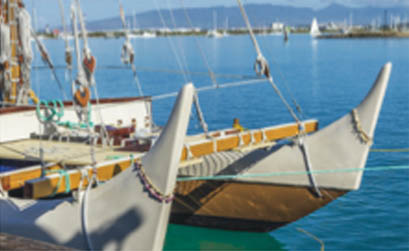 Hokulea
|
Lacy and Nainoa's father, Myron "Pinky" Thompson, shared with each other their visions of Hawai'i.
Observing Hawai'i from a porthole of the shuttle, Lacy saw the islands and the planet in one vision. The planet was like Hawaii, an island in space and we needed to take care of both if the planet was to remain a life giving home for humanity.
From Lacy's and Pinky's vision emerged a single vision of sailing Hokule'a around the world to share Hawai'i's values and practices for caring for our islands. Both Nainoa and his dad, Pinky, shared the assessment that Hawai'i was heading toward an unsustainable future.
"...if the knowledge and values that served Hawaiians were truly strong and inspirational, having enabled them to care for Hawai‘i and her seas for nearly 2,000 years through the careful management of natural resources to sustain a large, healthy population, we should go and share the knowledge and values with the world."-Myron Pinki Thompson, Polynesian Voyaging Society.
Our ancestors settled the most isolated archipelago on the planet. It is the furthest away from any land mass on earth. Hawaiians of ancient times took what land they had and made it productive. They developed and maintained practices to sustain themselves.
The stature and physique of the old-time Hawaiian was proof of the values his diet must have contained. The people were entirely dependent on the food the island and the surrounding ocean produced.
Today, we import over 95% of what we eat and do not begin to produce enough food for a population less than the population in the old days. There were no supply ships or airplanes to service the population with food. All food was grown and/or caught in the surrounding ocean.
The Koloa Field System is our last remaining example of how the Hawai'ians ingenuity turned inhospitable land productive and provided for the populace employing strict environmental and sustainable practices.
We need to preserve what we have left of the Koloa Field System as a lesson of sustainability and good environmental practices for present and future generations.
Western philosophy champions individual rights. Because of its remote location and limited land, Hawaiian rights are generational, for the future and beyond. Individual rights tax the environment without any thought given for sustainability.