Agricultural practices of our kupuna (ancestors) were reflected in almost every aspect of their culture. It influenced social patterns, land utilization and religion. Agricultural practices also affected the organization of the ahupua'a, a land unit considered to be semi- independent, and if necessary, self- sustaining.

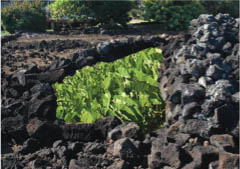 A rocky outcropping how taro was planted and irrigated there -Ken Posney Photo
|
Marginal land, often including thin strips fringing the wet fields was used for supplementary cultigens such as mai'a, ko and wauke. Agricultural fields were generally of two types, lo'i, (wet fields) and dry fields. The wet fields usually occurred in multiple terraced units and were used for kalo production.
The dry fields are varied in form. Some are similar to the terraced wet fields. Others are more amorphous, consisting of rock cleared sections usually in a low spot.
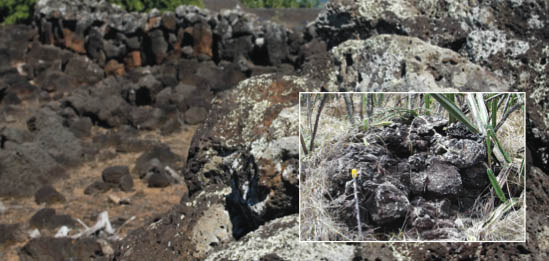 Rock outcropping, Insert -Rock mound (litho mulching) for planting 'uala -Ken Posney Photo
|
In many areas, land was so rocky that clearing of an entire field was impractical. In this case stones were simply thrown up in mounds for growing 'uala (sweet potatoes). The areas in between mounds were also cultivated.
The ingenuity and energy required to render this land productive and habitable is witnessed by the diversity of its alteration, rock clearing and mounding, construction of massive walls, platforms, enclosures and a complex stone-lined 'auwai and intricately designed field crop systems.
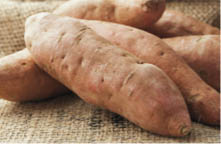 'Uala (Sweet Potatoe)
|
The larger 'auwai' were fed directly from Waikomo Stream. The water branched into smaller 'auwai' and eventually into lo'i.